Start with the overview, then choose the role you need to reference. These first-game essentials point back to the publisher’s English rules; keep the full rulebook beside you for individual card effects.
Sources checked · Independent reference
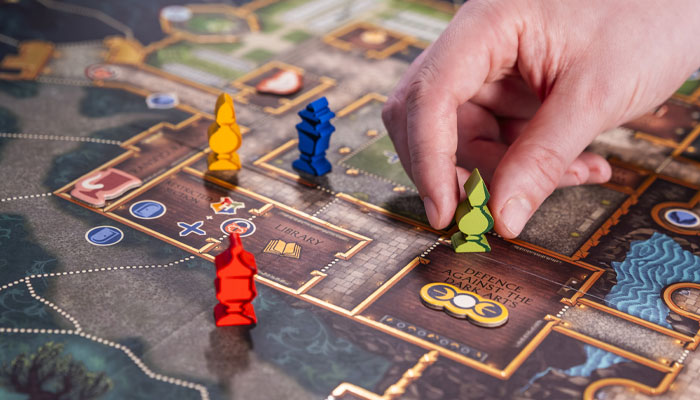
A closer look at the board and House pawns. Promotional image via Mojo Nation.
Before the first turn
Use the player-count setup checklist first. One player openly controls the Dark Arts; the others each choose a house. The House player to the Dark Arts player’s left begins, then turns continue clockwise.
A House player seeks two Defence Shields. At a shield space, exchange a Library Book card, a Parchment Scroll, and the item shown on that shield: either the Dark Detector or a D.A. Coin. A house’s win is individual, even when players help each other.
The Dark Arts player needs all three progress tokens and the required pawns at their destination. Their objective and turn options are different from a House player’s.
Reading the cards
Distinguish movement values from effect text and narrative text. A single movement value moves one pawn up to that many spaces. With two values, use each for a different pawn or combine both for one pawn; do not redistribute them into arbitrary amounts.
A card’s effect may be used before or after movement, subject to its conditions. Resolve the first card fully before playing a second card it permits. The lightning symbol marks a reactive effect: meet its trigger to use the effect outside your turn, or play the card normally for movement without that reactive effect.
For Dark Arts cards, the white, orange and red effect bands depend on the zone already reached on the Dark Arts Path. White is available from the start; the first orange and red spaces unlock their respective effects for the rest of the game.
Printed card instructions override ordinary rules when they conflict. Effects are optional unless the card says they must happen. This reference does not reproduce the card library.
Keep your role’s turn close.
HOUSE PLAYER
Explore · Learn · Replenish
Choose one main action on your turn.
Explore: play a card and resolve its movement and/or permitted effect. Bonus spaces activate when a pawn ends its move there.
Learn: at least one of your pawns must be outside protected areas. Discard one card to take an Acquire Row card or the top Acquire deck card. Alternatively, discard two for an Advanced Acquire Row card and advance one Loyalty space. Put the acquired card face down on top of your draw deck. Slide remaining display cards right and refill empty spaces from the left.
Replenish, in order: optionally discard cards, then draw up to a five-card hand; stand all your stunned pawns upright; advance the Dark Arts Marker one space and resolve the path consequence. A Replenish action draws at most five cards.
Bonus spaces
At a card-draw space, draw one card. At a card-acquire space, take an Acquire Row card or the top Acquire deck card for free; alternatively, discard one card for an Advanced Acquire Row card and advance one Loyalty space. These landing bonuses differ from the Learn action’s costs. A Play Again space grants another turn.
Free actions & turn end
Return a Hogwarts Token gained on an earlier turn to take an extra Explore action with a matching card, before or after the main action. You may hold only one Hogwarts Token at a time.
As soon as your pawns occupy two of your three Location-card areas, reveal those two cards, gain a Parchment Scroll and put those cards under the Location deck. After your first scroll, draw two replacement locations. After the second, also return your remaining location; you receive no more Location cards.
Resolve bonuses and free actions, discard played cards, then pass left.
DARK ARTS PLAYER
Explore · Replenish
Choose one main action on your turn. There is no Learn action.
Explore: play a card for movement and/or an unlocked effect. Deploying a reserve pawn costs one movement point onto a deployment space with no Dark Arts pawn, including stunned ones.
Bump after moving: end a move on a House pawn’s space. Choose one if several are present. Return that House pawn to the Great Hall and your pawn to reserve; take the matching House Marker if you do not have it. Collecting all active houses’ markers advances the path one space and returns the markers to their owners.
Acquire after bumping: once per turn, draw two Dark Arts Acquire cards; put one on top of your draw deck and the other under the Acquire deck. Multiple bumps do not repeat this reward.
Replenish, in order: stand all your stunned pawns upright, then draw up to a five-card hand. You cannot discard unwanted hand cards as part of replenishing. This action does not itself advance the path.
Resolve bumps and path advances, discard played cards, then pass left. Dark Arts pawns ignore obstacles, but cannot enter or cross protected spaces and cannot use secret passageways.
Loyalty, the Dark Detector & the room
End a move on a Dark Detector icon to advance one Loyalty space; relevant card effects and taking an Advanced Acquire card can also advance the track.
A House pawn reaching at least the fifth Loyalty space, ahead of the other houses, takes the Dark Detector. At the final space, an arriving pawn gains the Detector. If a house already occupies that space with the Detector, it passes the Detector to the arriving house, moves back one space and draws a card.
Spending the Detector for a shield moves your Loyalty pawn back three spaces. Return the Detector to its board space, or pass it directly to another qualifying house at space five or above. For tied qualifying houses, the first to have reached the fifth space or higher receives it.
The Room of Requirement opens when a house first reaches the fifth Loyalty space or higher. A house entering the open room takes a D.A. Coin, with a limit of one held at a time. If all houses drop below the fifth space, remove the room piece. A pawn inside must wait there until it opens again.
Ending the game
A House player wins
Collect two Defence Shields. The win belongs to that House player, rather than automatically to every house.
The Dark Arts player wins
Collect all three progress tokens and simultaneously place the required Dark Arts pawns at the Location-card destination. Taking the last progress token at the first red Event space also gives you a destination card and a three-pawn target; waiting until the next red Event space to take that token and card gives you a two-pawn target.
Events and the final stretch
A House Replenish action, an event instruction or collecting all active House Markers can advance the path. At an Event space, draw from its colour deck. Houses resolve their part first, if possible; then Dark Arts chooses the event benefit or that zone’s progress token. Each zone’s token must be taken before moving into the next zone. Discard the event after resolving it; earlier colour decks are no longer used after leaving their zone.
At the last path space, all players draw up to five cards and can no longer take Replenish. Card effects and draw spaces remain exceptions. Continue until someone meets their victory condition. If everyone runs out of cards first, the game is a draw.
Common rule checks
Can Dark Arts move through protected areas?
No. The four blue-shield spaces cannot be crossed or entered by Dark Arts pawns. Ignoring obstacles does not remove this restriction. Castle walls also remain impassable. Houses need a suitable card to cross obstacles, and only houses can use card-enabled secret passages (one movement point to pass through).
What counts as a legal move?
Move between spaces sharing a full border; castle walls cannot be crossed. House pawns can pass through or share spaces with other House pawns, but cannot backtrack during the same turn. A card must permit use of a Fly Off Point; the flight between Fly Off Points itself costs no movement. Keep obstacle and protected-area restrictions separate.
Is a stun the same as a bump?
No. When a House pawn ends on a Dark Arts pawn, both are stunned; the House player moves the Dark Arts pawn to an adjacent legal space. A stunned pawn lies sideways and cannot move by card movement or effect. In contrast, a Dark Arts pawn landing on a House pawn triggers the bump sequence above. Replenish stands your own stunned pawns upright.
Do newly acquired cards go straight into hand?
No. House Learn acquisitions and the Dark Arts bump acquisition go on top of the player’s draw deck. When a draw deck runs out, shuffle that player’s discard pile to make a new draw deck.
How do I gain a Library Book?
Visit the Library while holding no Library Book. Choose one of the two face-up books, immediately resolve its effect and any resulting effects, then place it on your board. Refill its display space. You may hold only one book at a time.
Where can I get the full official rules?
Open the publisher-linked Hive listing and find its Rulebook link in the How To Play section. DiceIndex does not host the PDF. Our references use printed pages; the publisher PDF arranges them in spreads.
Watch the game being taught
WATCH / Boardgames With Joe
How to play Defenders of Hogwarts
Boardgames With Joe introduces the game and its player roles. Keep the written turn references above nearby.
▶
How to play Harry Potter: Defenders Of Hogwarts - A MinaLima Game
Loading the player connects to YouTube and shares your IP address and browser information. Privacy details.